There is no single best time to post on Instagram in 2026, and the biggest studies prove it. Three of the largest, each covering a million posts or more, crowned three different winners this year: Thursday at 9 a.m., Wednesday afternoons, and Monday or Tuesday evenings. What they share is narrower but more useful: weekdays beat weekends for most accounts, midweek is strong, and the middle of the night is weak.
So treat any published time as a starting point, then let your own followers decide. Instagram already shows you when they are online; the rest of this guide explains how to read that chart, what to try first for your type of business, and how to confirm the answer in four weeks.
Key takeaways
-
Start with weekdays, late morning to early evening. It is the zone the major studies overlap on, and it fits most local and service businesses.
-
Your followers outrank any study. The “Most active times” chart in Instagram Insights shows when your own audience is online, once you have 100 followers.
-
Time matters less than people think. Posting at a good hour helps a post get early engagement, but a weak post at the perfect time still underperforms.
-
Reels reach beyond your followers. For Reels, your followers’ active times matter less, because most views can come from people who do not follow you yet.
-
Test before you settle. Four weeks of posting the same kind of content in two time slots gives you an answer you can trust.
What do the 2026 studies say is the best time to post on Instagram?
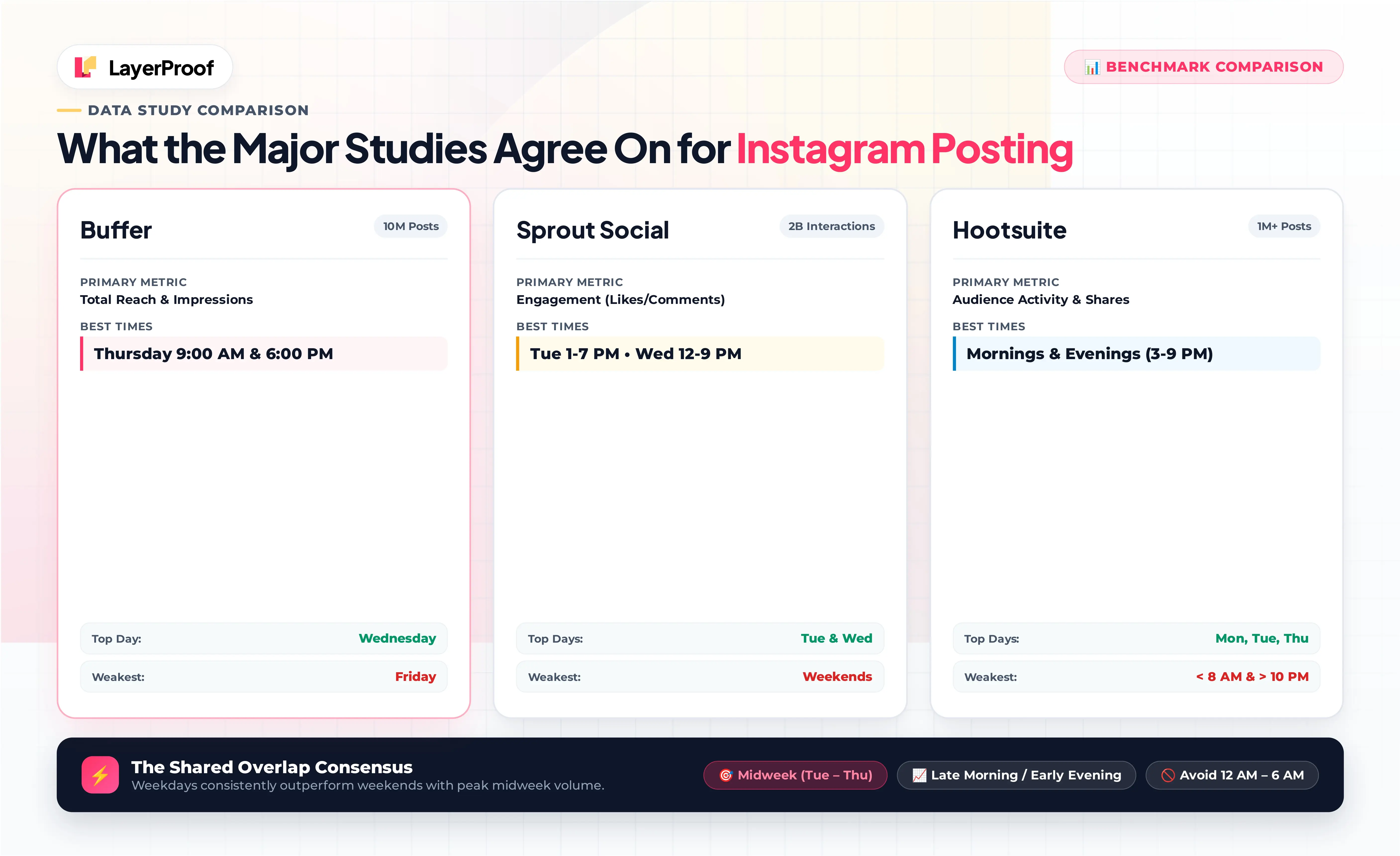
The three most-cited 2026 studies come from social media tool companies, each analyzing posts made through their own platforms. All times are in the poster’s local time.
| Study (2026) | What it measured | Best times on Instagram | Best day | Weakest |
|---|---|---|---|---|
| Buffer, about 10 million Instagram posts | Reach | Thursday 9 a.m.; weekday mornings and around 6 p.m. | Wednesday | Friday |
| Sprout Social, nearly 2 billion engagements across networks | Engagement | Tuesday 1 to 7 p.m., Wednesday noon to 9 p.m. | Tuesday and Wednesday | Weekends |
| Hootsuite, over 1 million posts | Engagement | Early mornings and early evenings, such as Monday 3 to 9 p.m. | Monday, Tuesday, Thursday | Before 8 a.m. and after 10 p.m. |
Why don’t the studies agree?
They are measuring different things for different accounts. One counts reach, the others count likes, comments, and shares. Each draws on its own customers, which skew toward different mixes of large brands, creators, and small businesses. And an average across hundreds of thousands of accounts hides the fact that a bakery’s followers and a software company’s followers open Instagram at different moments.
What do they agree on?
Across all three:
-
Weekdays generally beat weekends.
-
Midweek, Tuesday to Thursday, is consistently strong.
-
Very late night and the small hours of the morning are weak.
-
Your own data should override theirs. Each study says so itself.
That overlap is a sensible default for a new account: a weekday between late morning and early evening.
Does posting time really matter on Instagram?
It matters, but less than its share of advice suggests. Instagram explains that its feed ranking looks at how many people, and how quickly, like, comment on, share, and save a post. Posting when followers are online gives a post its best chance at that early burst.
Three things limit how much the hour decides:
-
Feeds are not in time order. Instagram ranks posts by predicted interest, so a strong post can surface hours later for a follower who opens the app in the evening.
-
Reels live longer. Reels can keep being recommended to non-followers for days, so the first hour is a smaller share of their total views.
-
Content quality dominates. A useful, well-made post at an average hour regularly beats a forgettable one at the “perfect” time.
The practical takeaway: pick good times, keep them consistent, then spend your effort on what you post rather than on shaving minutes off when you post it.
How do I find my own best time to post on Instagram?
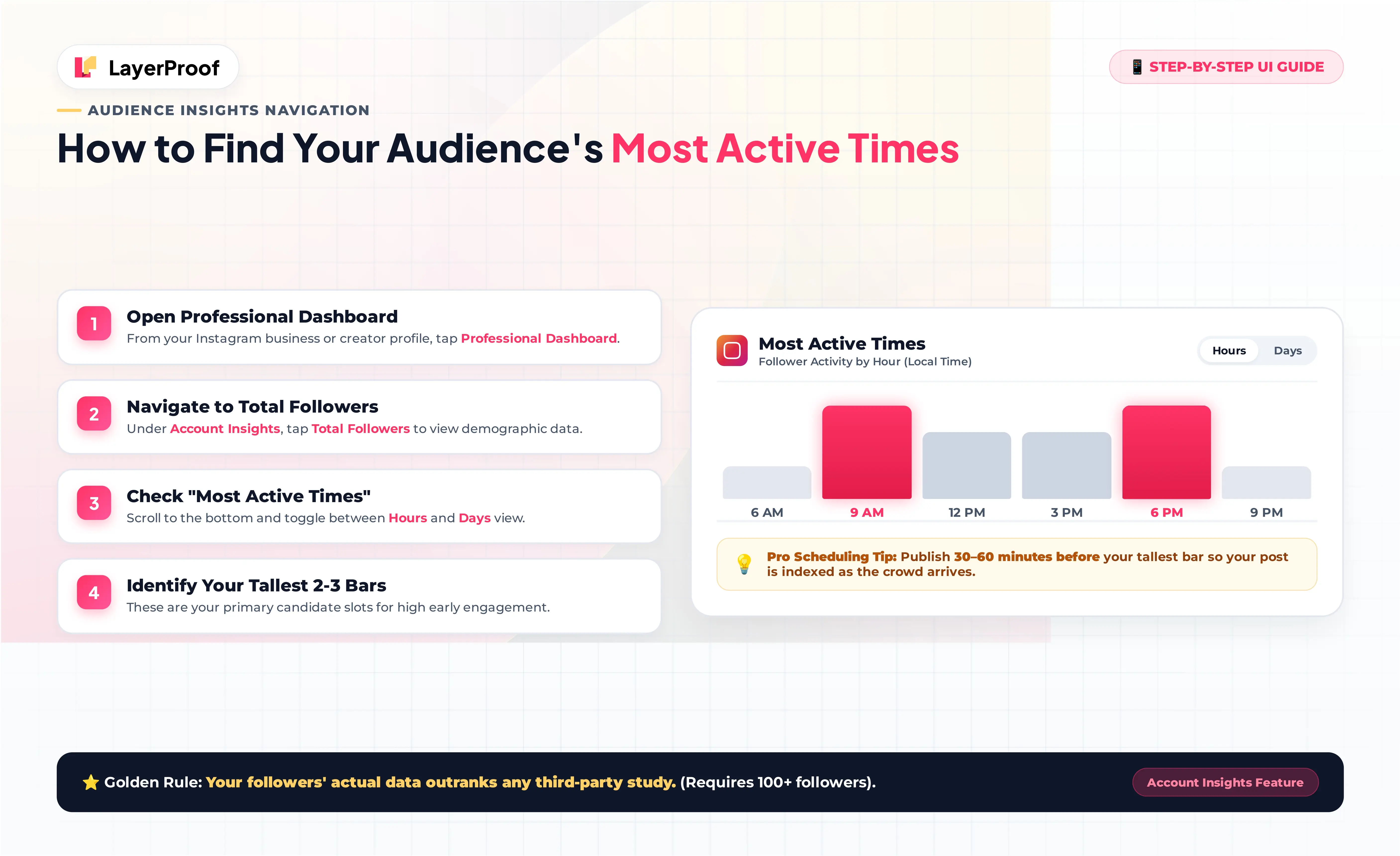
Instagram shows when your followers are online in a chart called Most active times. You need a professional account (Business or Creator) and at least 100 followers to see it.
-
Open your profile and tap Professional dashboard.
-
Tap Insights (on some app versions, Account insights).
-
Tap Total followers.
-
Scroll to the bottom to Most active times and switch between Hours and Days.
How should I read the Most active times chart?
Look for the two or three tallest bars on your busiest days. Those hours are your candidates. A few things to keep in mind:
-
The times follow your phone’s time zone. If most customers live in another time zone, convert before you schedule.
-
It shows when followers are online, not when they engage. Being online and having time to comment are not the same moment, which is why testing still matters.
-
It only covers current followers. If you are trying to reach new people through Reels and Explore, treat it as a rough guide rather than an answer.
-
Aim slightly ahead of the peak. Publishing 30 to 60 minutes before the tallest bar puts your post in place as the crowd arrives.
What if I have fewer than 100 followers?
Use the studies’ shared default, weekday late mornings to early evenings, and think about your customers’ routine: a lunch spot’s followers check menus before noon, while a salon’s clients often browse in the evening. Once you pass 100 followers, switch to your own chart.
What time should my type of business try first?
Until your own data says otherwise, start from your customers’ daily routine. Where the 2026 studies break out a matching industry, these starting points line up with them; the rest follow when each kind of customer is likely to be deciding:
| Business | Try first | Why |
|---|---|---|
| Cafes and restaurants | Weekdays 10:30 a.m. to noon; 4 to 6 p.m. | People decide on lunch and dinner shortly before mealtimes |
| Retail and boutiques | Weekdays noon to 3 p.m. | Lunch-break browsing and shopping |
| Salons, spas, and beauty | Weekday evenings, 6 to 8 p.m. | Clients plan appointments after work |
| Gyms and fitness | Early morning or early evening | Around the times people train |
| Real estate | Weekday lunchtime; Sunday late morning | Browsing breaks and weekend house-hunting plans |
| Professional and B2B services | Tuesday to Thursday, 11 a.m. to 2 p.m. | Midday breaks during the workweek |
Is the best time different for Reels, carousels, and Stories?
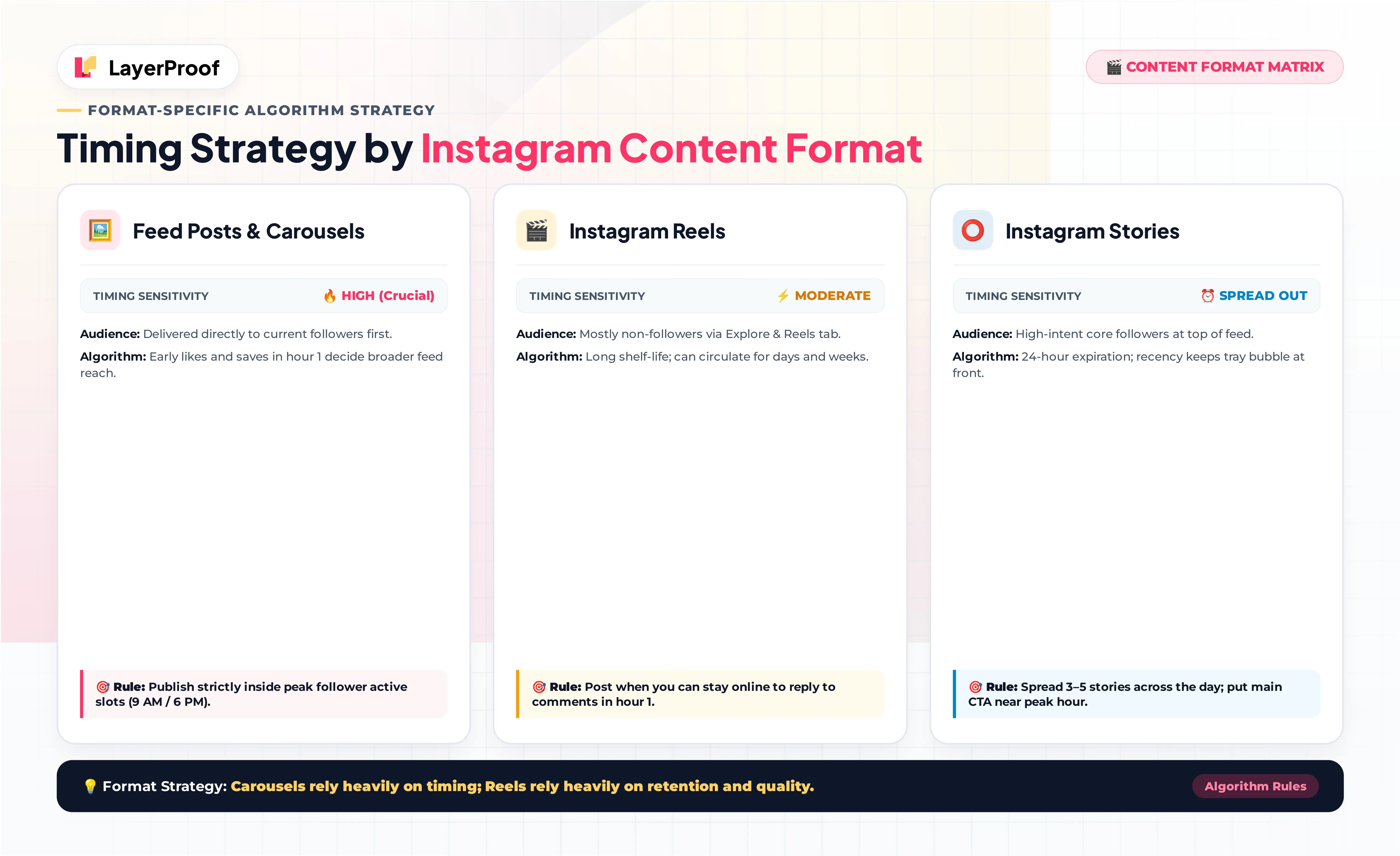
The hour matters most for feed posts and carousels, which depend on your followers seeing them early. Reels are less sensitive because they keep reaching non-followers; post them when you can stay around for the first hour to reply to comments. Stories disappear after 24 hours, so spread them through the day and put the most important one near your busiest hour.
How do I test my best time to post?
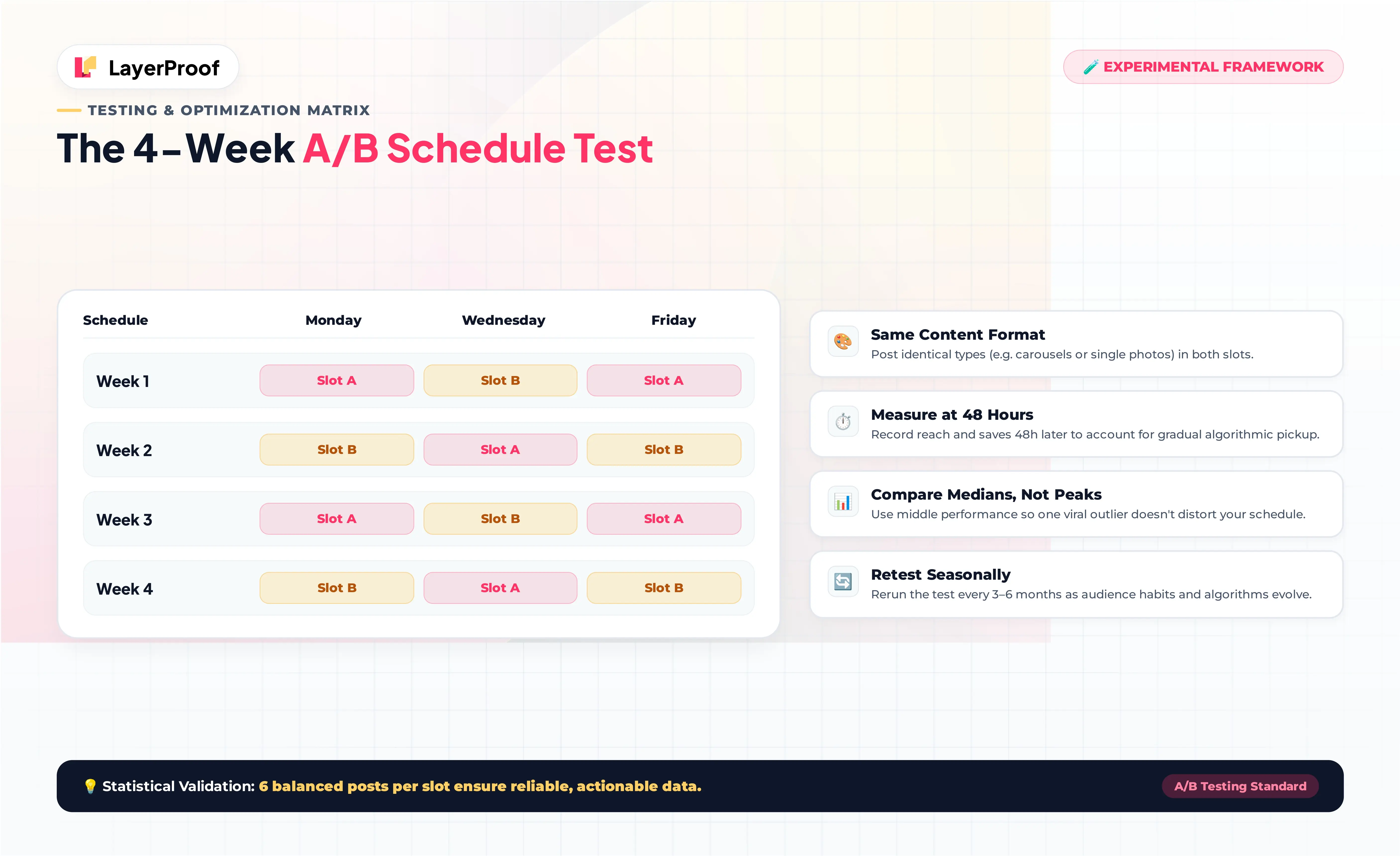
Run a simple four-week test with two time slots. Slot A is the peak from your Most active times chart (or your starting point from the table above). Slot B is a clearly different time you want to compare, such as morning against evening.
| Week | Monday | Wednesday | Friday |
|---|---|---|---|
| 1 | Slot A | Slot B | Slot A |
| 2 | Slot B | Slot A | Slot B |
| 3 | Slot A | Slot B | Slot A |
| 4 | Slot B | Slot A | Slot B |
That gives each slot six posts spread across the same days. Four rules keep the result honest:
-
Post the same kind of content in both slots. Do not put all your Reels in one slot and all your photos in the other.
-
Record each post’s reach and saves 48 hours after posting. That evens out posts that started slow.
-
Compare the middle result, not the best one. One viral post should not decide your schedule.
-
Keep the winner, then retest every few months. Audiences shift with seasons, school terms, and new followers.
If the two slots come out close, that is a useful answer too: it means timing is not your bottleneck, and your effort is better spent on the posts themselves.
How do I post at the best time without being on my phone?
Schedule. Knowing your best slot only helps if a post actually goes out at that slot, and for a business owner the best hour is often the busiest hour at work. The lunch rush is exactly when a cafe’s followers are scrolling, and exactly when the owner cannot.
Instagram’s own app lets professional accounts schedule posts, carousels, and Reels up to 75 days ahead, which is enough for a single account. If you also post to Facebook and TikTok, a shared calendar saves switching between apps. LayerProof lays your Instagram, Facebook, and TikTok posts out on one Calendar and publishes them directly at the times you choose, so your tested slot becomes a fixed part of the week.
The other half is having the posts ready. Matte builds each post on a canvas set to Instagram’s exact sizes, using your brand colors and fonts, and the first one takes about 5 minutes. Make the week’s posts in one sitting, drop them into your winning slots, and get started today on the four-week test.
Frequently asked questions about the best time to post on Instagram
What is the best day to post on Instagram?
Midweek, Tuesday through Thursday, is the safest choice. The 2026 studies name different best days, from Monday to Thursday, but all three rate the middle of the week highly.
What is the worst time to post on Instagram?
Late at night and in the small hours of the morning, when few followers are awake. For most business accounts, weekends are also weaker than weekdays, though businesses with weekend customers, like restaurants and real estate, should check their own chart.
Should I post at the same time every day?
It helps you more than it helps the algorithm. Instagram does not reward a fixed posting time on its own, but a regular slot makes it easier to stay consistent and to compare results week to week.
Which time zone should I use if my followers are in different places?
Use the time zone where most of your customers live. If they are split across regions, post at a time that falls within waking hours for your two largest groups, and check the cities list in Insights to see where they are.
How often should a business post on Instagram?
Pick a rhythm you can keep, such as three feed posts a week plus Stories on busy days. A steady rhythm at decent times does more than an irregular one at perfect times.
Does the best time change over the year?
It can. Holidays, school terms, summer schedules, and a growing follower base all shift when people open the app. Rerun the four-week test every few months, or whenever results drop without a clear reason.
References
- https://about.instagram.com/blog/announcements/instagram-ranking-explained · Instagram Ranking Explained · Instagram, accessed October 4, 2026 · Meta